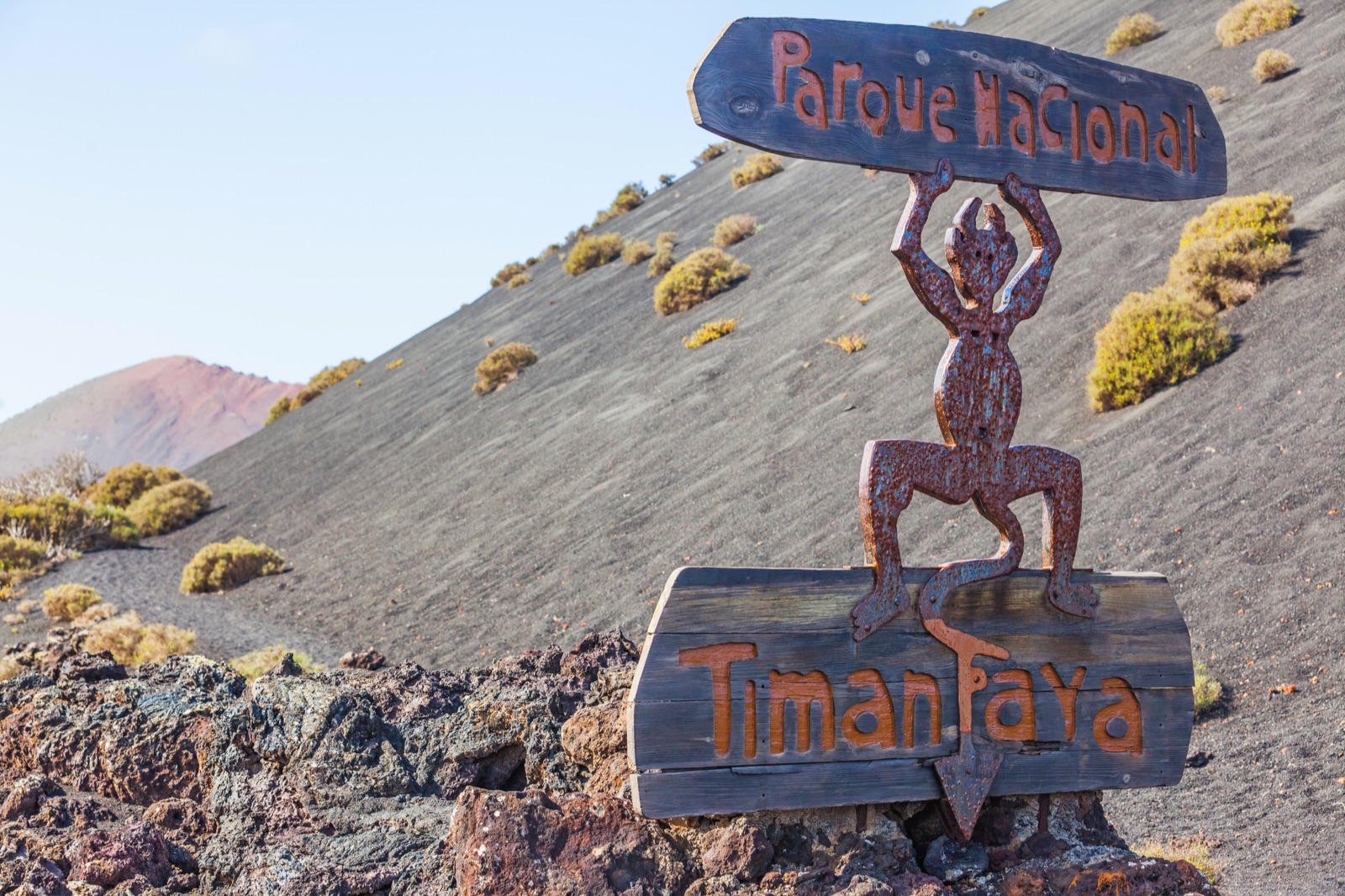
Timanfaya Tickets and the Volcano Route: How the Visit Works
A visit to Timanfaya is unlike a visit to most national parks. There are no trails to wander, no picnic spots and no scenic drives with lay-bys. Instead, the heart of the park — the Montañas del Fuego, the Fire Mountains — is visited in a carefully managed way: a timed ticket, a short drive to a single visitor area, demonstrations of the heat just below your feet, and a bus that carries you through the lava fields on a route you could never walk.
It is a tightly controlled experience, and it is worth understanding before you go. This guide explains how the tickets work, what happens at each stage of the visit, what you see on the Volcano Route, and how the tours that include Timanfaya compare.
The visit at a glance
A typical visit to the Montañas del Fuego follows the same sequence:
- Book a timed ticket for the day and time you want.
- Drive to the El Taro entrance on the LZ-67 and continue to Islote de Hilario without stopping.
- Park free at Islote de Hilario, validate your ticket at the ticket office and watch the geothermal demonstrations.
- Take the Ruta de los Volcanes bus through the lava fields.
- Eat at the El Diablo restaurant, or head on to the rest of the island.
The whole visit takes a couple of hours, most of it at Islote de Hilario and on the bus.
Tickets
Prices
A timed ticket to the Montañas del Fuego costs:
- €30 for adults.
- €15 for children aged 7 to 12.
- Free for children under 7.
How the tickets work
- Timed and dated. Each ticket is valid only for the day and time you book.
- No changes or refunds. Once bought, the ticket cannot be moved to another day or time, or refunded.
- One QR code per booking. A booking gives a single QR code for everyone in it, so the whole group enters together. If members of your party want to go at different times, they need separate bookings.
- On your phone. You do not need to print the ticket; you can show the QR code on your mobile.
- Be early. Arrive at the ticket office 15 minutes before your slot to validate your ticket. Once your booked time has passed, access cannot be guaranteed.
What the ticket includes
The ticket includes the Ruta de los Volcanes, the bus tour through the national park that starts at Islote de Hilario. The geothermal demonstrations take place at Islote de Hilario as part of the visit.
Booking tips
- Book before you drive. With timed slots and no changes, it is far better to know your time before you set off than to arrive and find the next slot is hours away.
- Choose a slot you can reach comfortably. Allow for the drive, the 15 minutes at the ticket office and a margin for traffic.
- Book everyone together if you want to enter together. Separate bookings mean separate QR codes and separate entry times.
- If you are on a tour, check whether tickets are included. Some island tours include them; the full-day island highlights tour, for example, can be booked with or without tickets.
Arriving: the El Taro entrance and Islote de Hilario
You reach the Montañas del Fuego on the LZ-67, the road that links Tinajo and Yaiza and serves all the park’s facilities. The entrance is called El Taro.
From the moment you pass El Taro, the rules are strict: you must stay in your vehicle all the way to Islote de Hilario. Stopping or getting out of the car inside the national park is not allowed. The temptation to pull over for a photograph is strong — the landscape is extraordinary — but the rule protects a very fragile environment.
At Islote de Hilario, the heart of the Montañas del Fuego, you will find:
- Free parking and free Wi-Fi.
- A café, a restaurant, a souvenir shop and toilets.
- The geothermal demonstrations.
- The bus service for the Volcano Route.
Some areas at Islote de Hilario have very high ground temperatures, so stay in the marked areas and follow the staff’s instructions.
The geothermal demonstrations
Islote de Hilario is where the heat of the volcano is closest to the surface. Only 15 metres down, the ground exceeds 600 degrees, and the demonstrations are designed to make that invisible heat visible.
The staff show what that heat does to everyday things placed at or just below the surface — demonstrations of what the park calls the geothermal anomalies. For most visitors, and for children in particular, it is the moment that makes the reality of an active volcanic landscape sink in: the ground you are standing on is hot enough to burn.
Watch from the marked areas, keep children close, and follow the staff’s instructions. The demonstrations are short, but they are one of the highlights of the visit.
The Ruta de los Volcanes
The Volcano Route is how you see the heart of the park. It is a bus tour that starts at Islote de Hilario and crosses the lava fields on a road closed to private traffic.
The facts
- Length: the park lists the route as 12 km.
- Duration: the park gives about 45 minutes; the ticket operator describes it as about 35 minutes by bus.
- The rule: you may not get off the bus at any point.
What you see
The route winds among craters, cones and lava fields that look barely cooled. It lets you see up close the traces of the eruptions and understand the history of the landscape — the flows that buried villages, the craters from which they poured, and the scattered signs of life slowly returning.
Because you cannot get off, the bus is the only way to see this part of the park. Sit by a window, have your camera ready, and let the landscape come to you.
Why you cannot get off
The lava fields are fragile. Footsteps damage the surface and the lichens and plants that are beginning to colonise it, and some of the ground is dangerously hot. Keeping visitors on the bus is how the park lets large numbers of people see the landscape without destroying it.
The El Diablo restaurant
The restaurant at Islote de Hilario is part of the story. In 1970, César Manrique and his team worked on the Timanfaya National Park, and the El Diablo restaurant is one of the results. Its most famous feature is its grill, which uses the heat of the volcano to cook food — the same heat that reaches 600 degrees only 15 metres below the surface.
Even if you do not eat there, it is worth looking at the building and the grill. It is one of the clearest examples of Manrique’s approach on Lanzarote: working with the volcanic landscape rather than against it.
Getting the most out of the bus
The Volcano Route is short, and you cannot stop, so a little preparation pays off.
- Get a window seat. The views are on both sides, but a window makes all the difference for photographs.
- Have your camera ready before you set off. Craters and lava formations come and go quickly as the bus winds through the park.
- Watch the textures. The lava fields are not uniform: there are smooth ropy flows, jagged fields of clinker, cinder slopes and crater walls in shades of black, red and ochre.
- Don’t spend the whole ride behind a screen. The route lasts well under an hour; look up as well.
Morning or afternoon?
The ticket system means you choose your time, so it is worth thinking about which suits you.
- Earlier slots leave the rest of the day free for the camels, which run from 9:00 to 15:00, the Mancha Blanca visitor centre, open until 16:00, and La Geria or El Golfo in the afternoon.
- Later slots suit a relaxed morning on the beach, but check that the camels and the visitor centre fit before they close.
- In the heat of summer, the lava fields and Islote de Hilario are exposed and shadeless; the bus is the most comfortable part of the visit.
Adding the camels and the visitor centre
The Montañas del Fuego are the centre of a Timanfaya day, but two other stops on the same road round it off.
The camel rides start at the Echadero de los Camellos, 2.5 km along the road from the El Taro entrance. Rides last 20 to 25 minutes, run from 9:00 to 15:00 every day except 25 December and 1 January, need no booking for small groups and cost €11 per person per ride, payable by card or cash. Children from 4 pay.
The Mancha Blanca visitor and interpretation centre, on the Tinajo–Yaiza road, opens daily from 9:00 to 16:00, with permanent exhibitions, a simulation room and a projection room. It is the best place to understand the eruptions before or after you see their results.
Our guide to walks, camels and the visitor centre covers both, together with the park’s free guided walks.
A little history
The landscape you see on the Volcano Route is young. The eruptions of 1730 to 1736 covered about a quarter of the island, burying villages and farmland and raising new mountains. Timanfaya was declared a national park by decree on 9 August 1974, protecting the landscape those eruptions left behind.
Tours that include Timanfaya
If you would rather not book tickets and drive yourself, several tours include the Montañas del Fuego:
Timanfaya half-day tour. The Volcano Route by bus with a guide, geothermal demonstrations at Islote de Hilario and an optional camel ride, in about 5 hours.
Timanfaya and La Geria. The Volcano Route and geothermal demonstrations, then the La Geria vineyards and the Green Lagoon at El Golfo, in about 5.5 hours.
Timanfaya, Jameos del Agua and Cueva de los Verdes. The Volcano Route, then two volcanic caves in the north, including César Manrique’s Jameos del Agua, in about 9 hours.
Full-day island highlights. Timanfaya’s Fire Mountains and geysers at Islote de Hilario, a stop at the camel centre, the northern caves, Haría’s palm valley and La Geria wine, in about 9 hours, with tickets included or not.
The tours page lists them with live prices.
Tour or independent?
- Independent suits you if you have a car, want to choose your time and like to combine Timanfaya with La Geria, El Golfo or the camels at your own pace.
- A tour suits you if you do not want to drive, want a guide’s commentary, or want to see several parts of the island in a single day without planning each stage.
Either way, the core of the visit — the demonstrations and the Volcano Route — is the same.
Accessibility
The Timanfaya visit is one of the more accessible volcanic experiences in the Canary Islands, precisely because so much of it happens by car and bus:
- You drive to the visitor area and park at Islote de Hilario.
- The Volcano Route is seen seated on the bus.
- The demonstrations take place in the visitor area.
The ground at Islote de Hilario is volcanic, and some areas are hot, so take care with footing and follow the marked areas.
What to wear and bring
The Montañas del Fuego visit is mostly by car and bus, but a few things make it more comfortable:
- Sun protection. Islote de Hilario is exposed, and the lava fields reflect the heat.
- Comfortable closed shoes. The volcanic ground at Islote de Hilario is uneven, and some areas are hot.
- Water, particularly in summer.
- Your phone, charged, with the ticket’s QR code ready to show.
- A camera with space on the memory card for the Volcano Route.
Rules to remember
- Stay in your vehicle from the El Taro entrance to Islote de Hilario.
- Do not get off the Volcano Route bus.
- Stay in the marked areas at Islote de Hilario, where some ground is very hot.
- No pets, except accredited assistance dogs.
- Arrive 15 minutes early for your slot.
Frequently asked questions
How much does it cost to visit Timanfaya?
A timed Montañas del Fuego ticket costs €30 for adults, €15 for children aged 7 to 12, and nothing for under-7s.
Can I change my Timanfaya ticket?
No. Tickets are valid only for the day and time booked, with no changes or refunds.
What is the Ruta de los Volcanes?
A bus tour through the lava fields of the national park, starting at Islote de Hilario. The park lists it as 12 km and about 45 minutes; the ticket operator describes it as about 35 minutes. You may not get off the bus.
Can I walk in the Montañas del Fuego?
No. The lava fields at the heart of the park are seen from the Volcano Route bus. For walking, the park runs free guided routes elsewhere, and a guided hike crosses the lava fields in the volcano natural park next to the national park.
How hot is the ground at Islote de Hilario?
It exceeds 600 degrees only 15 metres below the surface. That heat is what the geothermal demonstrations show, and what the El Diablo restaurant’s grill uses to cook.
Do tours include the Timanfaya ticket?
Many do; some offer it as an option. Check what each product includes before booking.
Is there anywhere to eat at Timanfaya?
Yes. Islote de Hilario has a café and the El Diablo restaurant, whose grill uses the heat of the volcano. César Manrique’s team worked on the park in 1970, and the restaurant is one of the results.
Can I ride a camel on the same visit?
Yes. The Echadero de los Camellos is on the same road, 2.5 km from the El Taro entrance. Rides last 20 to 25 minutes and run from 9:00 to 15:00.
Why can’t I get off the Volcano Route bus?
To protect the lava fields. The surface and the plants and lichens beginning to grow on it are easily damaged, and some of the ground is dangerously hot. The bus lets everyone see the heart of the park without harming it.